Star Clusters and Asterisms
Stars are gigantic, self-luminous spheres of gas in space, composed primarily of hydrogen and helium. They generate their own energy through nuclear fusion triggered by extreme heat and pressure in their interiors. Our Sun is also a star. The fact that other stars appear only as tiny points of light at night is due to their unimaginably vast distances.
Do you know how many little stars there are…
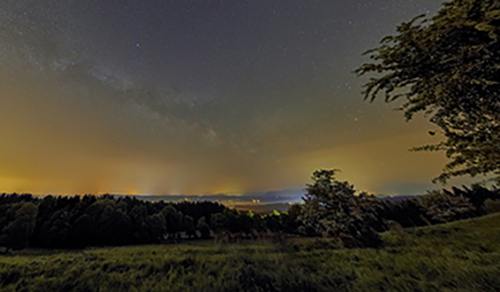
On a moonless winter night, far removed from disturbing light sources, 9,110 stars should be visible to the naked eye across the entire sky. This figure can be found in the "Yale Bright Star Catalogue."
However, there are far more stars in the sky than are visible to the naked eye. As early as Galileo Galilei—when he pointed the telescope he invented in 1609 toward the heavens—recognized that the Milky Way actually consists of a multitude of individual stars.
The larger a lens or telescope is, the more celestial bodies become visible. A telescope with a diameter (astronomical term: aperture) of six centimeters reveals approximately 150,000 stars across the entire sky.
All these stars belong to the Milky Way, our home galaxy. In total, the Milky Way contains approximately 200 to 300 billion stars. The exact number is difficult to determine, as large parts of the galaxy are hidden behind clouds of dust. Scientists rely on models and extrapolations in this regard.
Since at least the observations made by Edwin Hubble in 1920, it has been clear that many "nebulous patches" in the night sky are not gas clouds within the Milky Way, but rather other distant galaxies.
It was only with modern space telescopes that it finally became possible to estimate the number of these distant systems—and, by extension, how many stars exist in the entire cosmos.
Today, the total number of galaxies in the observable universe is estimated at approximately two trillion. According to current estimates, galaxies contain, on average, about one billion stars. This amounts to two sextillion stars in the entire observable cosmos—a two followed by 21 zeros.
- Observable UniverseFor one thing, the “observable cosmos” is not identical to the entire cosmos—and we do not know how large the latter is. Perhaps the volume of the entire cosmos is finite; then again, the cosmos might be infinitely large—in which case there would be an infinite number of stars.
- A Look into the PastAnd secondly, a simple multiplication of the number of stars by the number of galaxies calculates the stars at the present moment—that is, in the contemporary cosmos.
However, we observe the cosmos as it exists today only within our immediate vicinity—otherwise, we are looking into the universe's past. This is because the light from distant galaxies requires a great deal of time to reach Earth: for instance, if the light from a galaxy takes one billion years to travel to us, then we see that galaxy exactly as it appeared one billion years ago. This means that many celestial bodies whose light reaches Earth today have, in reality, long since ceased to exist. - How many can we actually observe?Taking into account the formation and evolution of stars over the course of cosmic history, approximately 80 trillion of them should currently be observable.
These are promising prospects for (amateur) astronomers—provided that technical possibilities are unlimited.
Info: A trillion is a number with 18 zeros.
Distance of the stars from Earth
If all stars emitted the same amount of energy, it would be easy to determine their distance:
The fainter stars would then be more distant. However, stars emit varying amounts of energy. We refer to this as their differing luminosity. A bright star in the sky could be a distant giant or a nearby dwarf. One way to determine the distance of a nearby star is to measure its position at two different points in time while the Earth orbits the Sun.
Trigonometric parallax measurement
The distance of a star from Earth was determined for the first time in 1838 by Friedrich Wilhelm Bessel, using trigonometric parallax measurement.
Principle:
If you view a table from a distance of about five meters and alternately cover your left and right eye, you will have the impression that the table “jumps” back and forth.
Due to the distance between your eyes—approximately six centimeters—two distinct images are essentially formed. Your brain processes these into a perception of distance, allowing you to estimate roughly how far away you are from the table.
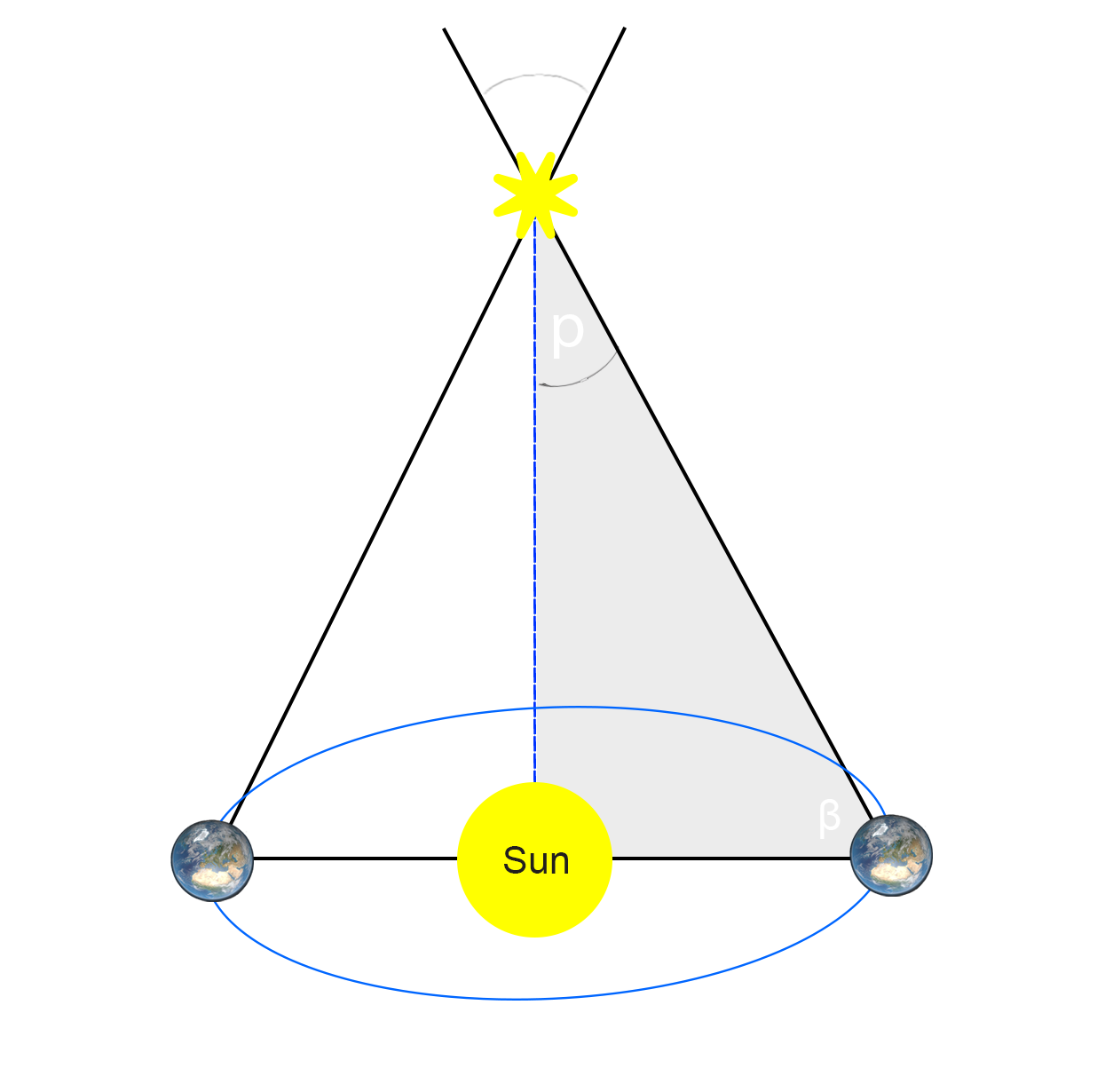
The principle of trigonometric parallax is also suitable for determining distances in astronomy.
Due to Earth's orbit around the Sun, the Earth occupies different positions — and thus presents different observation angles, α and β — relative to a star at the winter and summer solstices (see the graphic on the left).
According to the table example above, these positions would be our left and right eyes respectively.
If we take measurements at the winter solstice and again at the summer solstice, we obtain the angles α (at the winter solstice) and β (at the summer solstice).
From this, we can calculate the angle γ.
According to trigonometry, this is: γ = 180° - α - β
Due to the great distance to Proxima Centauri, the angles α and β differ by only 1.536" (arcseconds). The angle γ is therefore very small. The greater the distance to the object being observed, the smaller the angle.
In contrast to the term "light-year" used in popular science, astronomers employ the unit of distance known as the parsec because it is based directly on actual observational data (angular measurements).
Parsec is a portmanteau of the words "parallax" and "second".
Definition of Pasec:
By definition, one parsec is the distance at which the angle γ — subtended by the line between Earth and the Sun (approx. 150 million km)—measures exactly one arcsecond (1/3600 of a degree).
The distance between Earth and the Sun is referred to as the Astronomical Unit AU; see image.
If the angle γ subtended by the Earth–Sun line is exactly one arcsecond (1"), a parsec amounts to approximately 3.26 light-years or about 31 trillion kilometers (31,000,000,000,000 km).
As shown in the image for the star Proxima Centauri, the parallax angle p (gray triangle)
is half the angle γ:
i.e., 1.536″ / 2 = 0.772″
However, the measured value p for Proxima Centauri in our example is only 0.772 arcseconds (0.772").
Let us substitute this value of 0.772" into the formula
for the distance
r = 1pc x 1" / p
...the following result is obtained for the distance between Earth and Proxima Centauri:
r = 1pc x 1" / 0,772" = 1,302 pc
In light-years, this is
1,302 pc x 3,262 light-years = 4,247 Lichtjahre.
In kilometers, this is:
4,247 x 9,461 x 1012 km = 40.180 billion kilometers
If this calculated result is checked against the relevant tables, one obtains 4.234 light-years. This demonstrates how effectively stellar distances can be determined using trigonometric parallax.
Today, trigonometric parallax can be determined with an accuracy of 0.01″.
- Distance to our Sun Our Sun, too, is a normal star. It appears larger to us than the many dots in the night sky only because we are so close to it—"only" about 150 million kilometers away. Sunlight takes eight minutes to reach us.
In other words: when we delight in a beautiful sunset, the sun has actually already set eight minutes earlier. Yet, the sun is still considered one of the smaller stars. But if sunlight takes eight minutes just to reach us, how far away—or indeed, how large—must the other stars in the night sky be?
Wikipedia: Sun
Spectroscopic Distance Measurement (Brightness)
Method: The type of a star can be determined based on its starlight through spectral analysis. Since stars of the same type also exhibit physically similar luminosity, their distance can be inferred from their known luminosity and the fainter brightness measured from Earth.
Wikipedia: Astronomical spectroscopy
Cosmic Distance Rulers (Standard Candles)
Method: Specific types of stars - such as Cepheids, whose pulsation period is directly linked to their brightness - are observed.
If the object's actual brightness is known, the decrease in brightness reveals its exact distance.
Wikipedia: Cosmic distance ladder
Redshift
Wikipedia: Red shift
Colors and Luminosity
In the Milky Way alone, billions of stars gather —and alongside it, trillions of other galaxies drift through the cosmos.
In the universe, stars are primarily classified based on their spectral class (surface temperature and color) and their luminosity class (size and evolutionary stage). The combination of these properties determines a star's appearance, mass, and lifespan.
Spectral Classes (Color and Temperature)
- O and B:
Very hot, massive, and luminous. They shine with a bluish to white-blue light (e.g., Rigel or Spica).
- A and F:
White to yellowish-white stars that shine very brightly (e.g., Sirius or Vega).
- G:
Yellow stars. Our Sun belongs to this category.
- K and M:
Cool and extremely long-lived stars. They shine orange to red and, at over 75%, are the most common stars in the universe (e.g., Proxima Centauri).
Thus, a G9 star is hotter than a K0 star. Incidentally, our Sun is a G2 star—a relatively hot one among the yellow-shining stars.
For the order of the spectral classes, the English mnemonic often used is:
"Oh, Be A Fine Girl, Kiss Me!" genutzt.
Luminosity Classes (Size and Evolutionary Stage)
-
I. Supergiants
Supergiants are among the most massive and luminous stars in the universe. They can be up to several hundred times larger than our Sun, and their luminosity exceeds that of the Sun by a factor of ten thousand to one hundred thousand. They are located in the upper region of the Hertzsprung-Russell diagram (e.g., Betelgeuse).
-
II. Bright Giants
In astronomy, bright giants are defined as stars that are significantly larger and more luminous than normal giant stars (Class III), but do not quite attain the gigantic dimensions and masses of supergiants (Class I).
-
III. Giants
Giant stars are massive celestial bodies in a late stage of stellar evolution that have expanded enormously. Their gigantic luminosity is the result of their immense surface area—they often shine with 10 to several hundred thousand times the brightness of the Sun, consuming their fuel at a rapid pace in the process.
-
IV. Subgiants
Subgiants (luminosity class IV) are defined as stars that are brighter than normal main-sequence stars (class V dwarfs) but possess lower luminosity than true giant stars (class III). They mark a brief yet significant phase in stellar evolution—occurring shortly after the hydrogen in the core has been depleted and before the star evolves into a red giant.
-
V. Main-Sequence Stars (Dwarfs)
Main-sequence stars (often referred to as dwarfs, luminosity class V) are the most common stars in the universe. Their luminosity is directly coupled to their mass and temperature and is described in astronomy by the so-called mass-luminosity relation. They spend the majority of their lives fusing hydrogen into helium. 90% of stars belong to this class.
-
VI. Subdwarfs
Subdwarfs are faint stars of luminosity class VI. Unlike main-sequence stars, they exhibit significantly lower luminosity and a smaller radius at the same temperature. In the Hertzsprung-Russell diagram, they lie 1.5 to 2 magnitudes below the main sequence.
-
VII. White Dwarfs
White dwarfs are extremely compact stellar remnants (approximately the size of Earth) formed by the collapse of Sun-like stars. Due to their small radiating surface area, their luminosity is very low—typically ranging only between10-4 und 10-3 times that of the Sun.
Despite their extremely high surface temperatures—initially reaching up to 100,000 K—they are no larger than Earth. It is precisely because they lack this radiating surface area that they shine so faintly.
Evolutionary Stages of Stars in the Hertzsprung-Russell Diagram (HRD)
Stars move in regular patterns within the Hertzsprung-Russell diagram throughout the course of their formation, life, and death.
The underlying data for millions of stars (absolute magnitude, color, and distance) were collected as part of the ESA Gaia mission between 2013 and March 2016. These data are freely available and can be analyzed using suitable software for specific stellar regions—for example, star clusters.
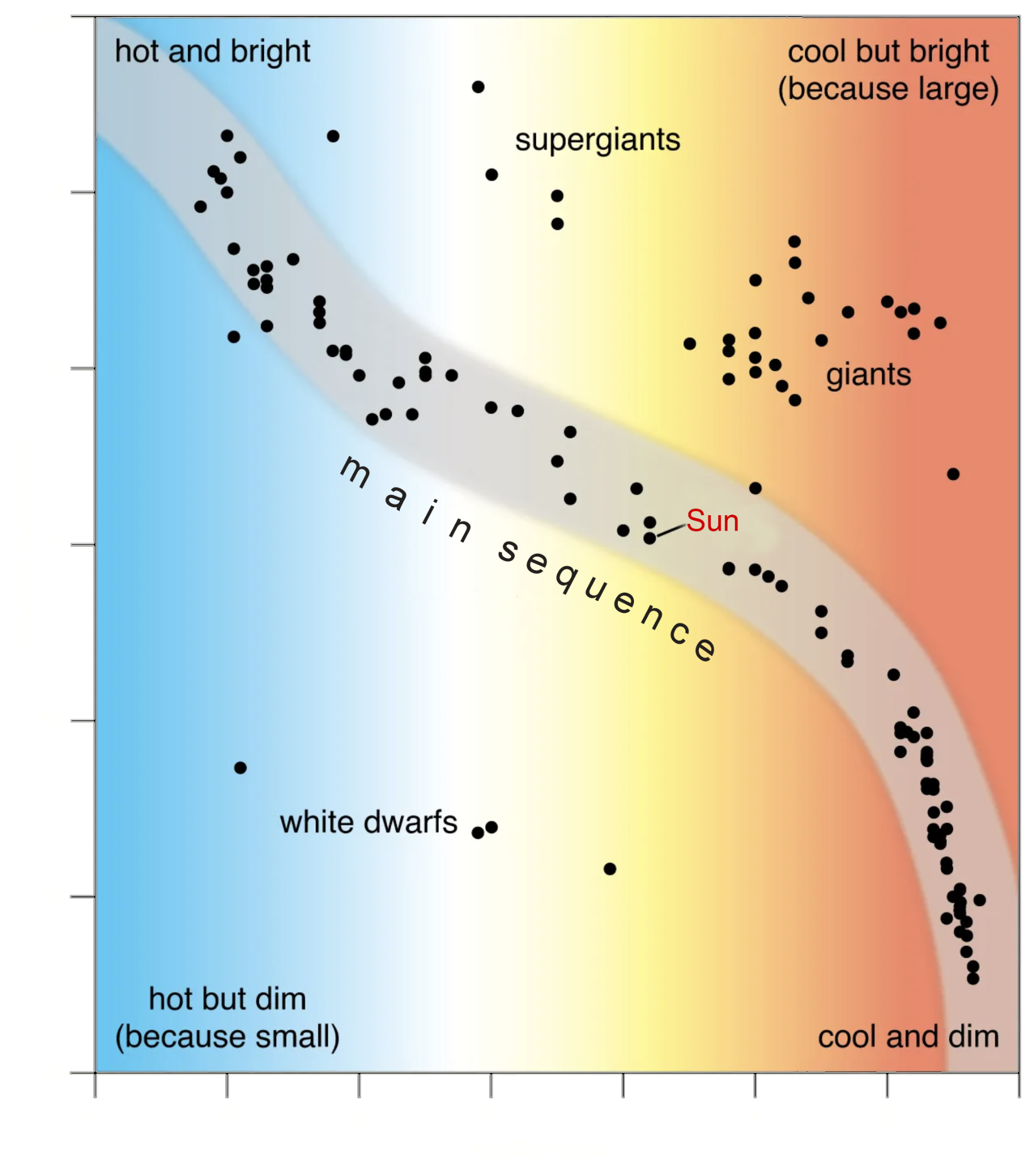
The following properties are plotted on the two axes of the diagram:
- The vertical axis (Y-axis):
The luminosity or brightness of the star. Moving upwards, the stars become progressively brighter. - The horizontal axis (X-axis):
The surface temperature in Kelvin or the spectral type (color).
Important:
The temperature decreases from left to right! Hot stars (blue) are located on the left, and cool stars (red) on the right.
-
The Main Series (Dwarves)
Here lies the majority of all stars. In their interiors, they burn hydrogen into helium (just like our Sun). A simple rule applies: the hotter a star, the brighter it shines. The Sun lies right in the middle.
-
Red Giants
These stars are massive and cooler (and therefore shine red), yet possess an extremely high luminosity. They are located in the upper right corner of the diagram. This represents the late phase in the life of a star.
-
Supergiants
Even larger and brighter than red giants. They are located at the very top of the diagram.
-
White Dwarfs
These are the extremely dense, burnt-out remnants of smaller stars. They are very hot (located toward the left), but due to their small size, they are extremely faint (located far down).
The 4 Most Important Areas in HRD
The Hertzsprung-Russell Diagram, illustrated using the star cluster NGC 7798 (aka Caroline's Rose)
In the Hertzsprung-Russell diagram of NGC 7798, a prominent branch extending from the main sequence toward the red giant region is visible. This indicates the advanced age of the star cluster. The brightest stars are orange giants of spectral type K4, with an absolute magnitude of -2.3.The majority of the other bright stars are giants and subgiants; they appear to have evolved off the main sequence of the H-R diagram. The calculated age of the cluster is approximately 1.5 billion years, making it older than most star clusters of this type.
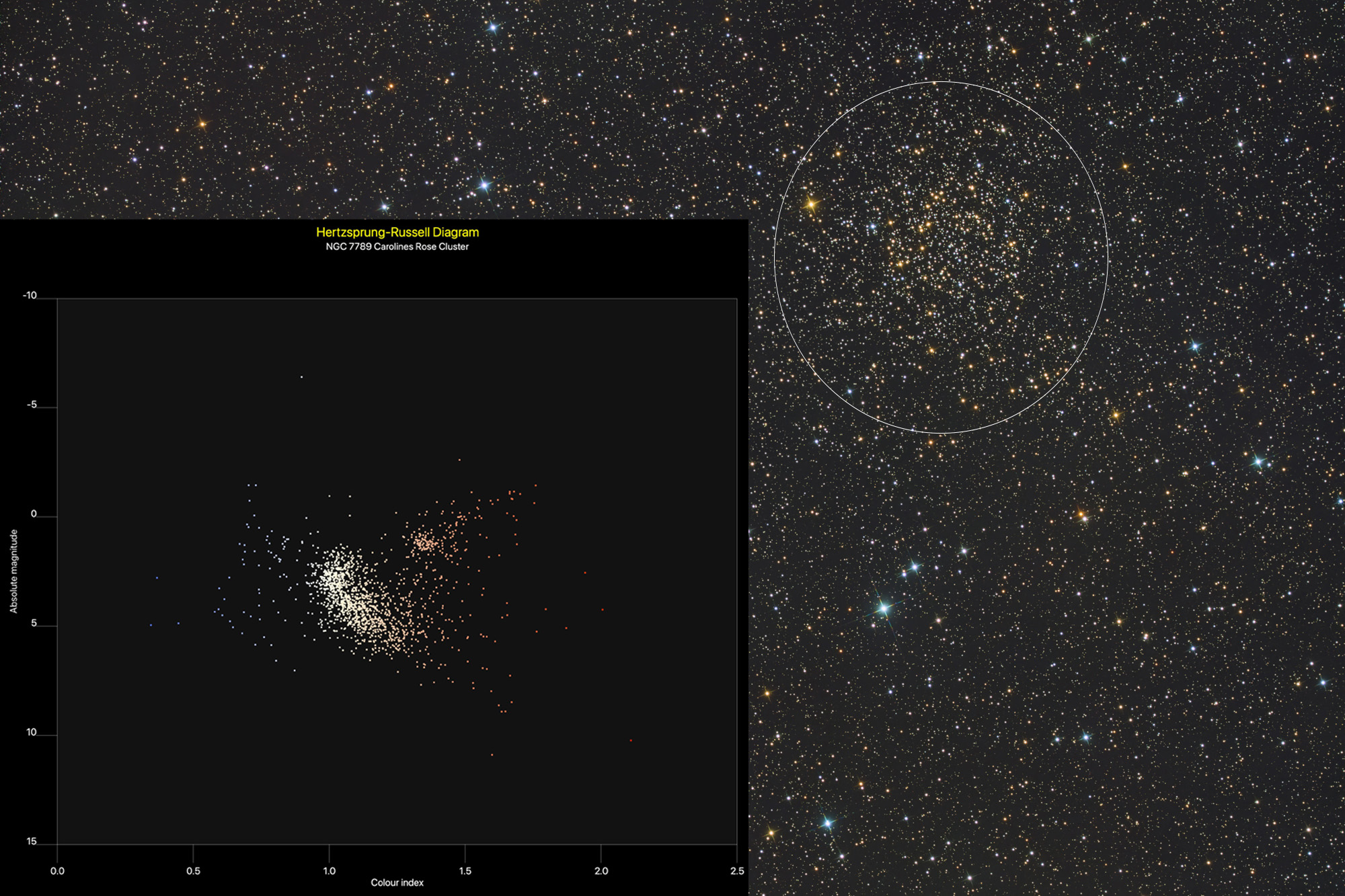
Hertzsprung-Russell diagram (left) of the open cluster NGC 7789, Caroline's Rose (circled).
Star clusters
A star cluster is a region of significantly increased stellar density compared to the surrounding area of a galaxy.
Open Star Clusters
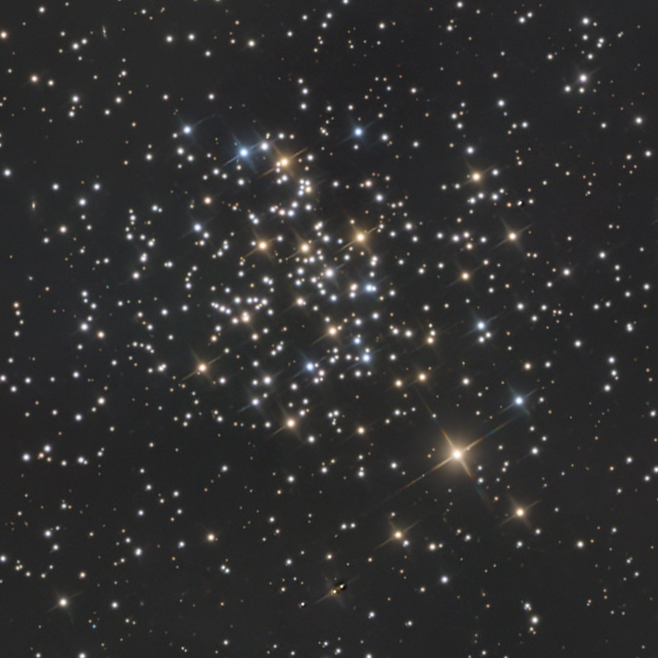 Open star clusters are loose associations of stars that can number many hundreds or even thousands of stars. In cosmic terms, they are young structures—barely a few hundred million years old.
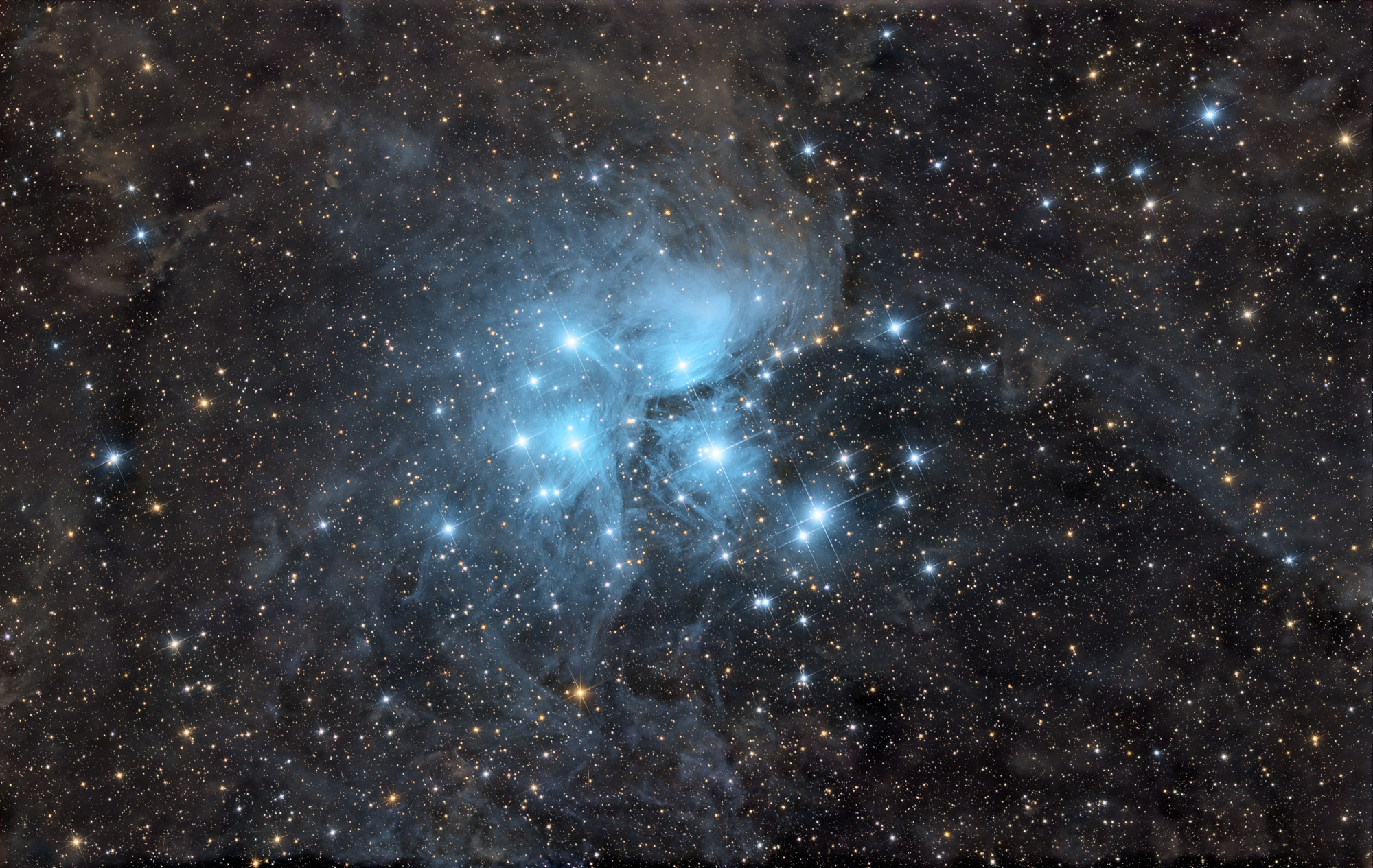
The Pleiades—also known as Messier 45 or the Seven Sisters—is arguably the most famous open star cluster. It belongs to the constellation Taurus and is visible in the sky from autumn until approximately February.
Info:
 Subaru is the Japanese name for the Pleiades open star cluster. The brand name and logo of the Japanese automaker are based on this star cluster, with the six visible stars symbolizing the merger of five companies to form Fuji Heavy Industries (now Subaru Corporation).
Wikipedia: Star cluster
Wikipedia: Constellation
Globular cluster
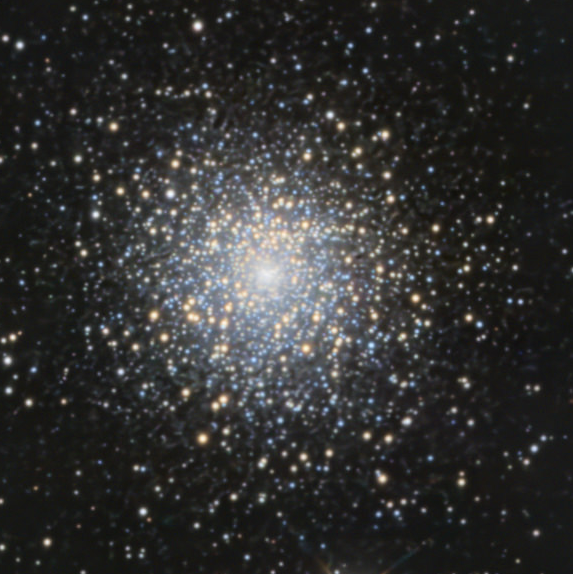 A globular cluster is a specific type of star cluster consisting of a large number of stars arranged in a spherical distribution around a common center of mass.
These clusters are held together by gravity and are typically located outside the plane of a galaxy—most often in the halo region surrounding spiral galaxies. Globular clusters possess the following characteristic features:
-
Compact spherical shape
The stars in a globular cluster are densely packed and form a nearly spherical structure. The stars are relatively close to one another compared to the average distances between stars in a galaxy.
-
High stellar density
Globular clusters can contain hundreds of thousands or even millions of stars concentrated within a relatively small volume. This high stellar density is one of the reasons why globular clusters can appear so striking and impressive in the sky.
-
Old Stars
Most stars in a globular cluster are very old. They are among the oldest stars in the universe and were often formed at a time when galaxies were still in the process of formation.
-
Small amounts of interstellar gas and dust
Unlike younger star clusters, globular clusters contain only small amounts of interstellar gas and dust. This is because these materials have, over time, been consumed by the stars or expelled from the cluster.
Asterisms
 In astronomy, an asterism is a prominent group or pattern of stars that forms a recognizable shape for observers on Earth, but is not among the 88 officially defined constellations.
An asterism can be part of a constellation—such as the Big Dipper within the constellation Ursa Major—and may even span across multiple constellations, like the Summer Triangle, which is formed by the three bright stars Deneb, Altair, and Vega.
Wikipedia: Asterism
Explore More Astronomical Objects