Galaxy clusters
The Formation of Galaxy Clusters and Superclusters
Galaxies are social entities, rarely appearing in isolation. Because they contain enormous masses of stars, gas, and dark matter, their mutual gravitational pull draws them together into groups and clusters..
Since the Big Bang, the universe has been expanding, with all stars and galaxy clusters moving away from one another. The cosmos is constantly stretching. However, the gravity within these galaxy groups and clusters is powerful enough to hold them together despite this cosmic expansion.
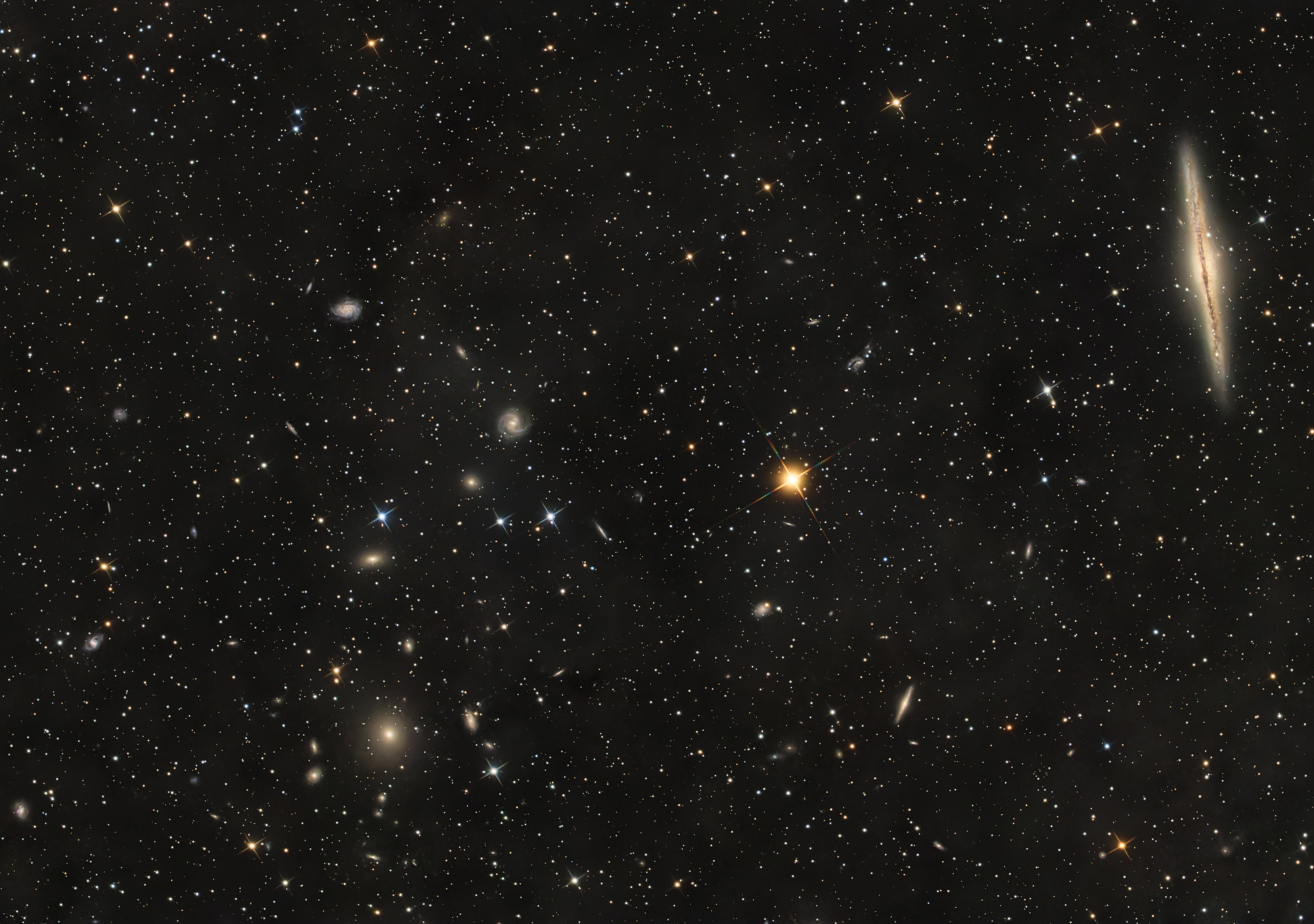
Over eons, galaxy groups attract additional galaxies, growing and merging into massive clusters that harbor thousands of galaxies..
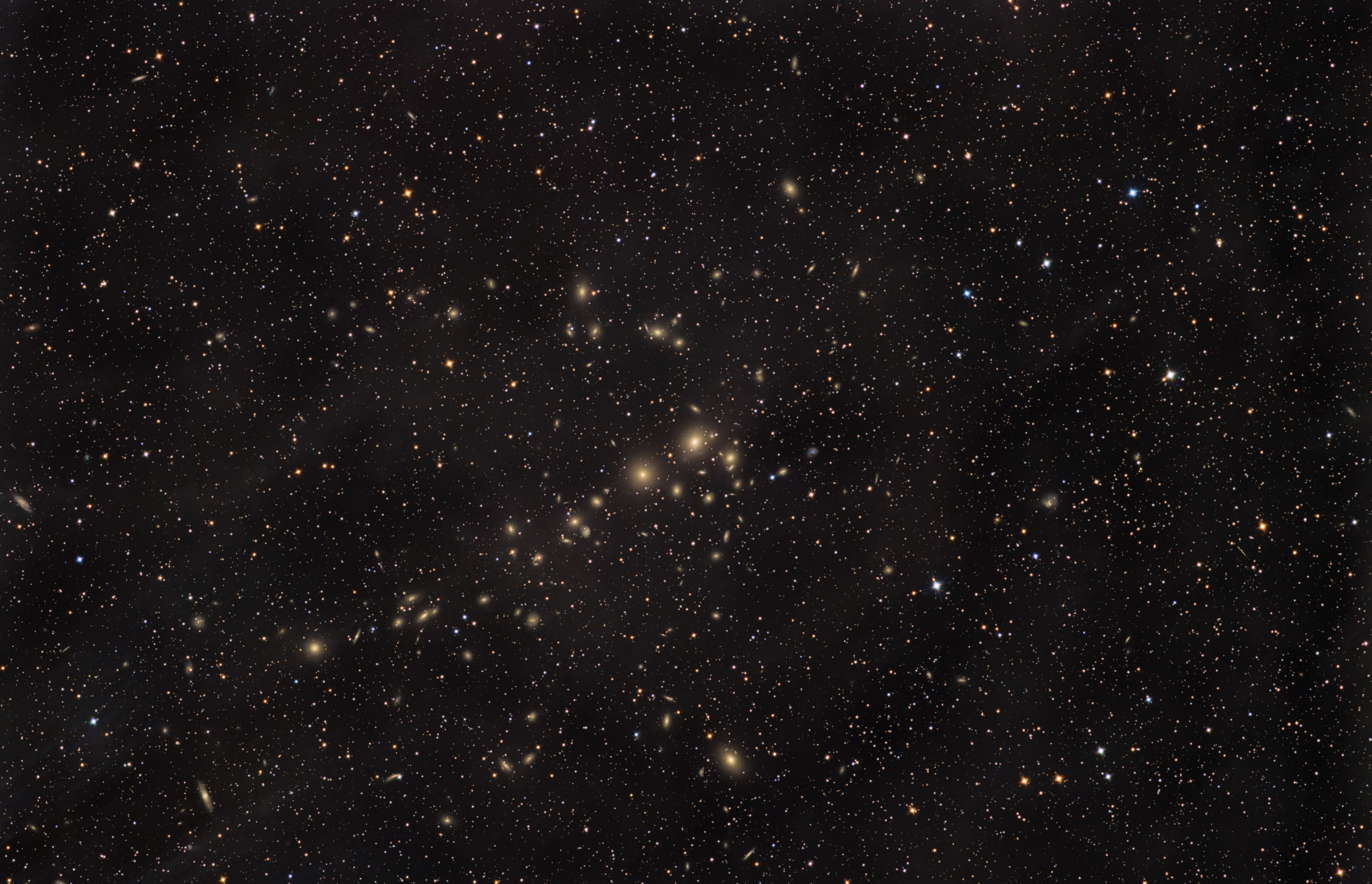
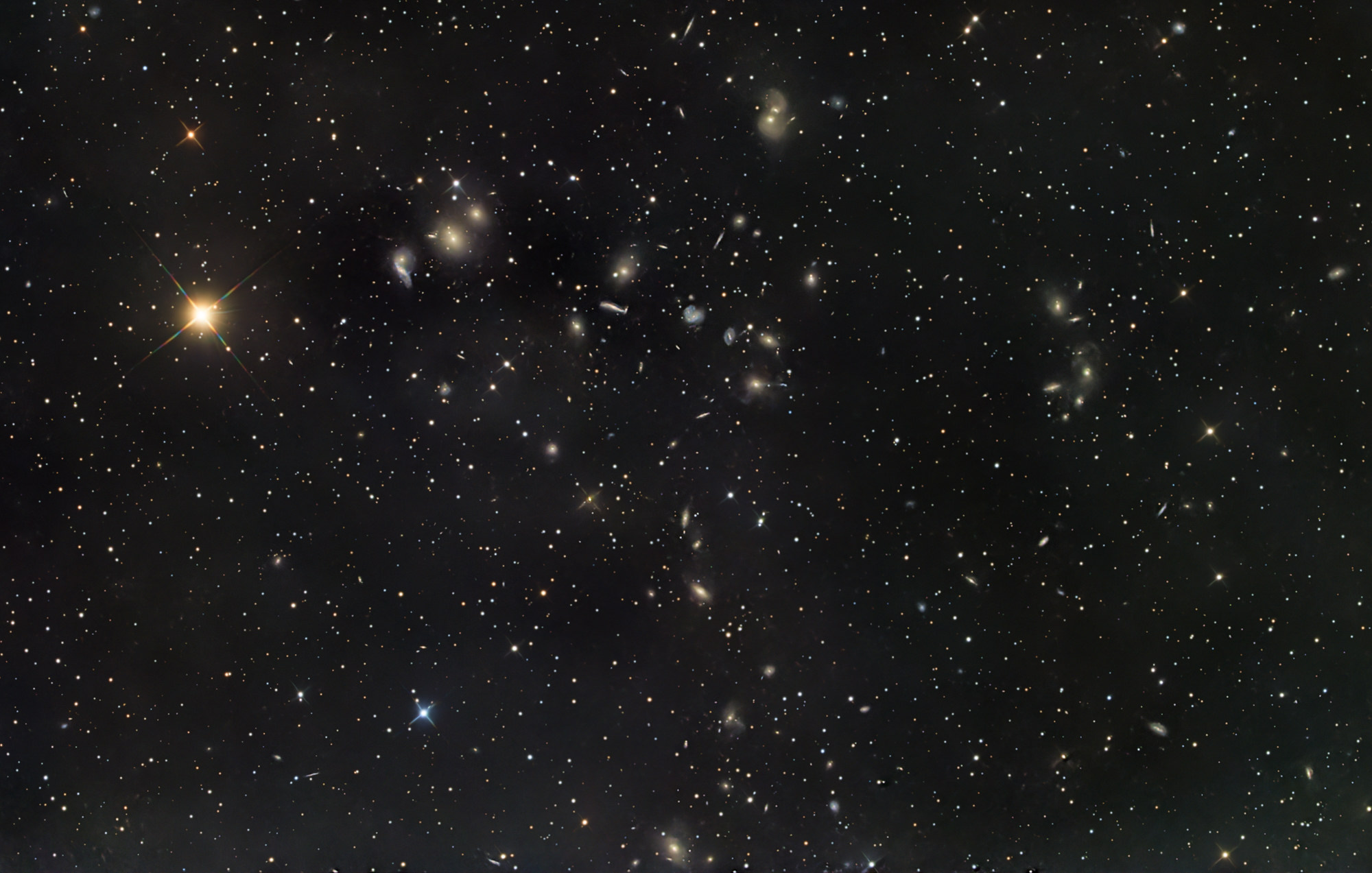
These extraordinarily large systems are known as galaxy clusters. The Virgo Cluster in the constellation Virgo, for example, consists of around 2,000 galaxies. The entire cluster spans an apparent size of 8 degrees in the night sky—making it 16 times larger than the full moon!
Dark matter is an invisible form of matter in the universe that neither emits nor reflects light. It is not directly visible, but it makes itself known through its gravitational force. Without dark matter, galaxies would fly apart, as it acts like an invisible "glue" that holds the stars together.
-
Ingredients
Galaxy clusters consist of galaxies (of various types, such as spiral, elliptical, or irregular galaxies), hot gas (the intracluster medium, which often emits X-rays), and dark matter, which accounts for the majority of the mass and stabilizes the structure.
-
Size and Mass
They span millions of light-years and typically have a mass of about 10^{14} to 10^{15} solar masses.
-
Origin
Galaxy clusters form through the gravitational attraction of smaller groups of galaxies and matter over billions of years. They are part of the large-scale structure of the universe, which forms a network of filaments, walls, and voids.
-
Examples
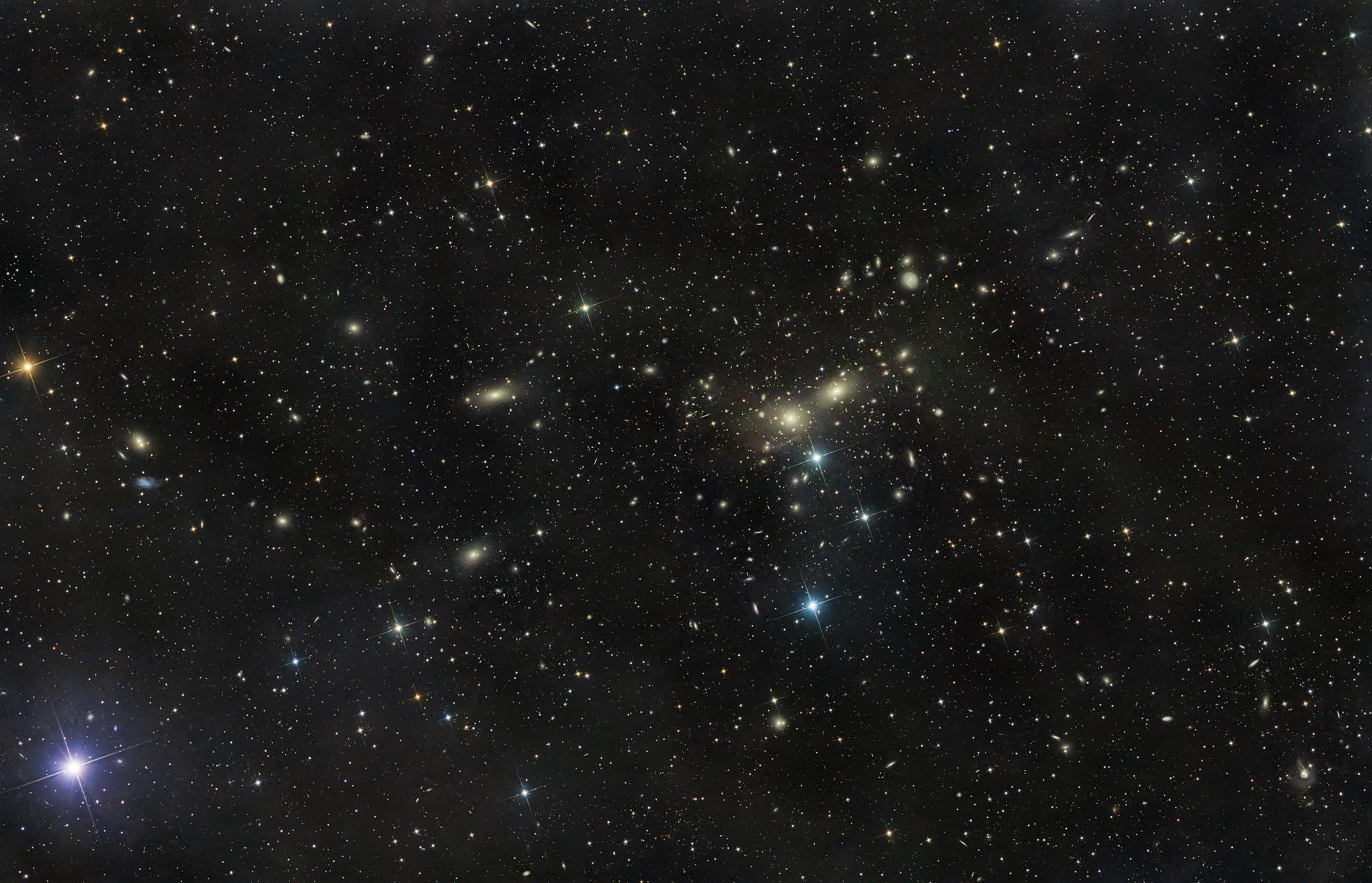
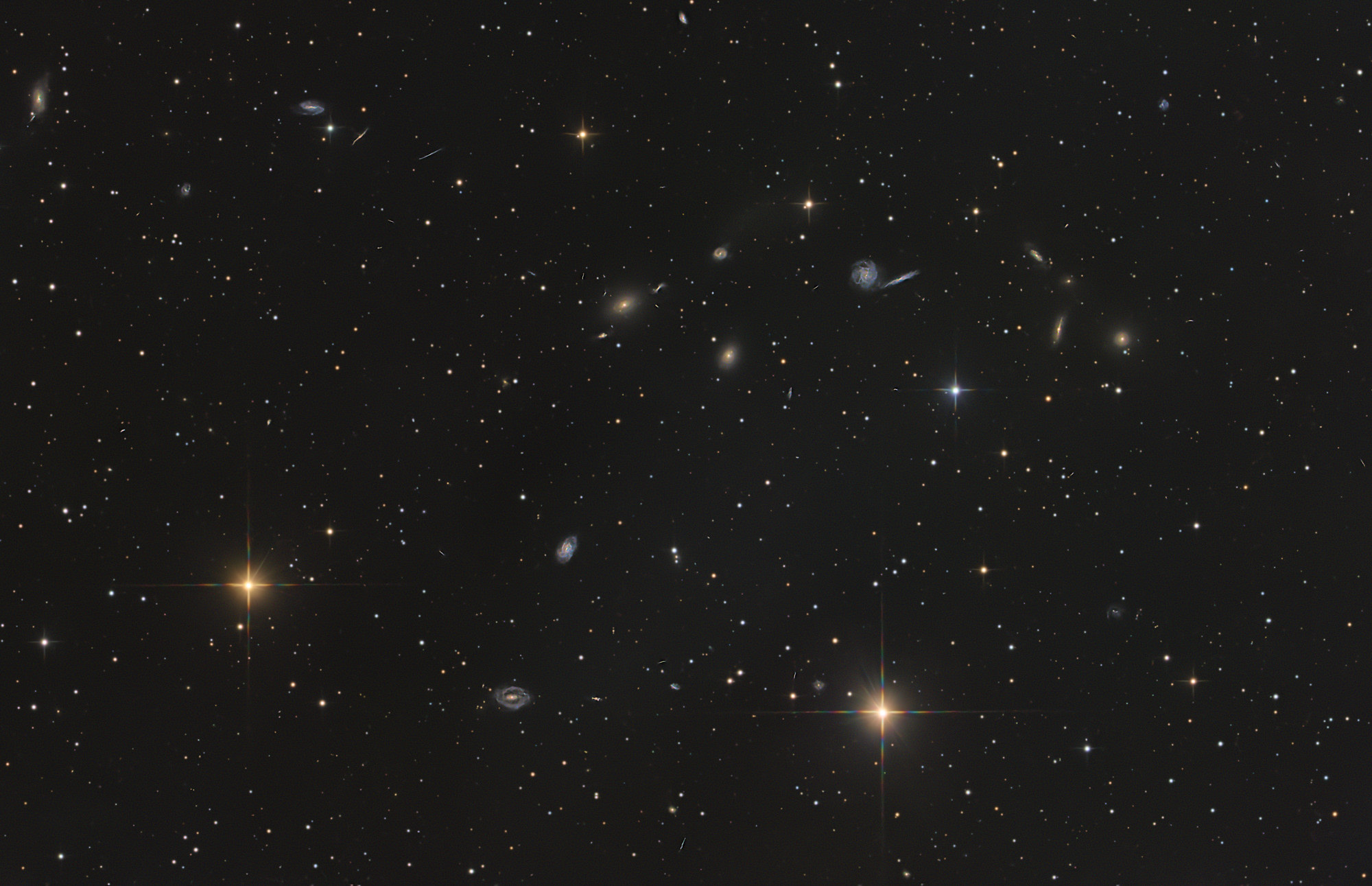
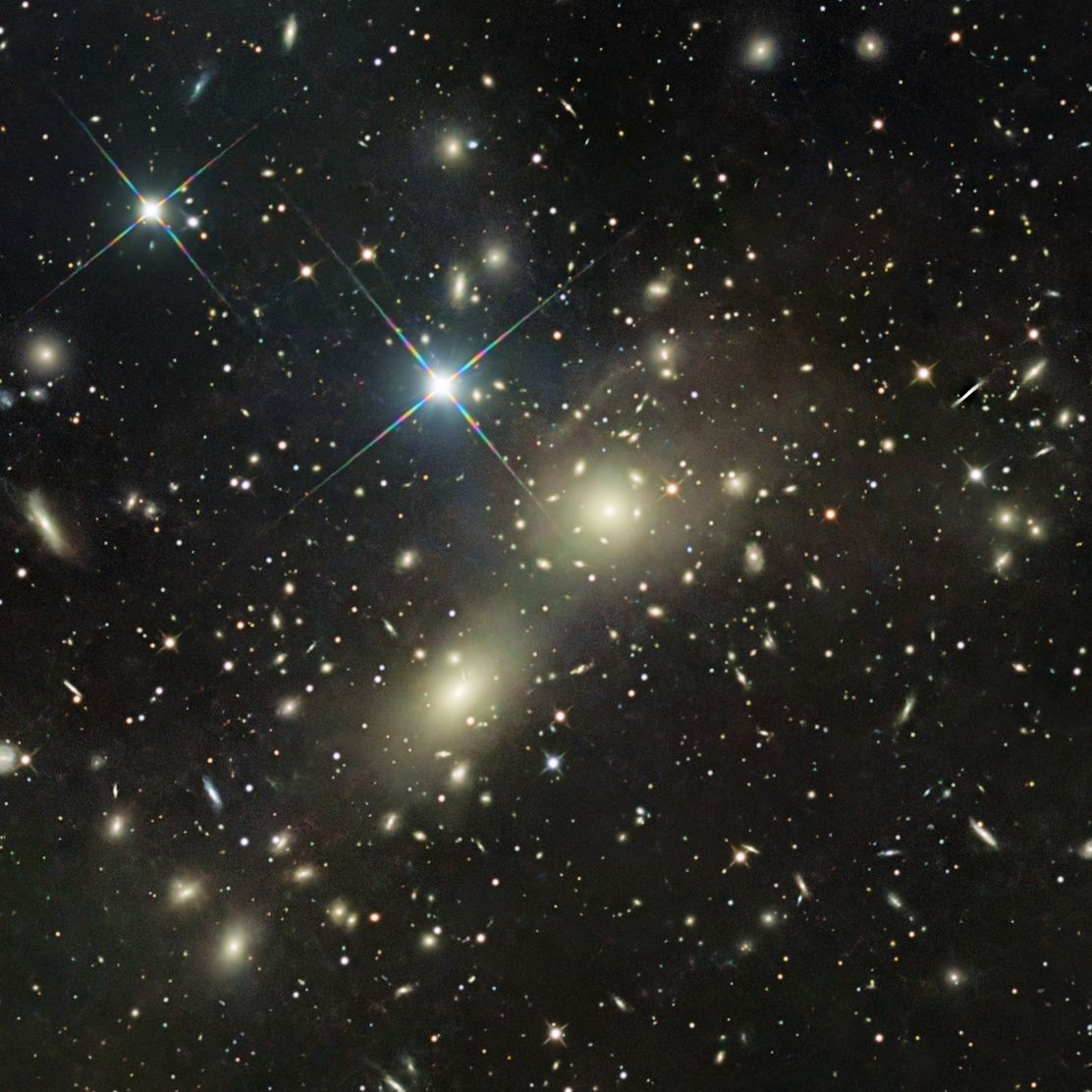
Well-known galaxy clusters are the Virgo Cluster (approximately 54 million light-years away; contains our Milky Way) and the Coma Cluster.
-
Meaning
They are important for cosmology, as they provide clues regarding the distribution of matter, the expansion of the universe, and the role of dark matter and dark energy.
Dark Matter and Dark Energie
Dark matter and dark energy are the two greatest unsolved mysteries of modern cosmology. Although their names sound similar, they have completely opposite properties and effects. Together, they account for about 95% of our universe.
Dark Matter – Glue and binding Skeleton
Galaxies often form small groups or unite into gigantic clusters and superclusters containing thousands of galaxies. The immense gravitational fields of these galaxies act upon one another; they interact and sometimes even consume each other, stripping away individual stars and gas nebulae. This process creates gas bridges where new stars are born.
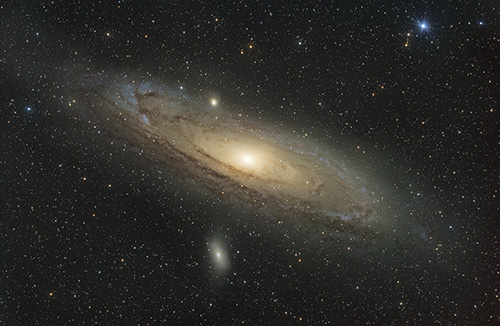
It also happens that one galaxy passes right through another. For instance, our Milky Way is currently approaching the Andromeda Galaxy. In about 4 to 5 billion years, a major collision will likely occur. However, contrary to what one might expect, this will happen without a grand uproar. The distances between individual stars are so vast that they will not collide, even if our galaxy moves completely through the Andromeda Galaxy.
cf. section
Galaxies and galaxy groups / Galaxies with a peculiar appearance.
Much like the planets in our solar system, galaxies also orbit one another, moving at speeds of up to thousands of kilometers per second.
However, there is a striking difference here:
The orbital velocity of the planets depends on their distance from the Sun. Gravity and centrifugal force balance each other out in each case. Orbital speeds decrease with increasing distance (Kepler's Law).

In contrast, the orbital velocity of the stars within a galaxy, or that of its orbiting dwarf galaxies, remains nearly constant. The orbital velocity is independent of how far the star or the orbiting dwarf galaxy is located from the core of the central galaxy.
For the galaxies to orbit each other at this speed, a greater mass is required as an 'engine' than these galaxies themselves possess.
The question arises: Where does this 'greater engine power' or mass come from?
There must be something additional that allows the galaxies to orbit one another at this speed.
Astrophysics refers to this force/mass as Dark Matter.
Dark matter is an invisible form of matter in space that emits or reflects no light. It is not directly visible, but it makes itself known through its gravitational pull.
Without dark matter, the galaxies in galaxy clusters would fly apart. Dark matter acts like invisible 'glue' and holds galaxies and stars together like a 'skeleton'.
Dark Energy
The only thing the Gauls in the Asterix comic books feared was not the Romans, but rather
"that the sky might fall on their heads."
It was not that long ago that astronomers provided proof that this fear is completely unfounded.
In 1998, however, two research groups from the USA independently published precise measurements of the expansion of the universe. They were able to prove that the expansion of the universe is not slowing down, but on the contrary, is accelerating!
The researchers Saul Perlmutter, Adam Riess, and Brian Schmidt were even awarded the Nobel Prize in Physics in 2011 for this discovery.
Yes, everything is flying apart faster than anyone thought. To this day, it remains impossible to explain why this is the case.
And whenever science does not know why something behaves the way it is observed, it invents a new term: Dark Energy
Dark Energy is therefore the term used for an effect that explains the accelerated expansion of the universe.
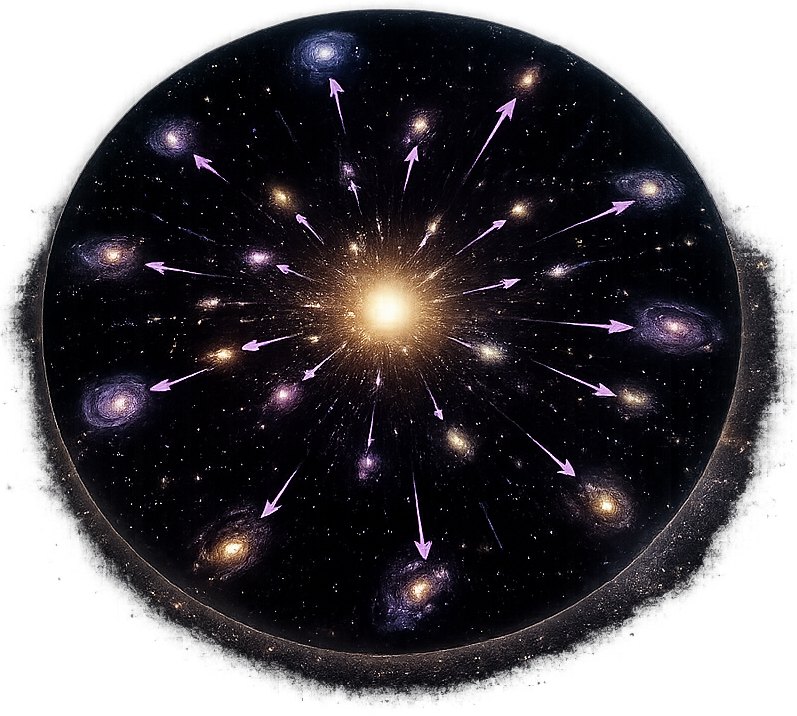
Scientists have also discovered that in its early phase, the universe drifted apart much slower than previously assumed. Consequently, the universe is older than previously thought.
In the meantime, there is a plethora of highly complex theories attempting to explain dark energy. In practice, however, virtually nothing is known about dark energy to this day.
New data is eagerly anticipated—for instance, from the European space probe Euclid, which launched on July 1, 2023.
It remains exciting ...
What lies in the distant future?
Two scenarios are currently being discussed within the scientific community:
- The Big Freeze
This scenario is currently considered the most likely by scientists.
- The Principle
Driven by dark energy, the universe expands forever. - The Process
Galaxies drift so far apart that light can no longer travel from one to another. Aging stars run out of fuel, and no new gas remains to form subsequent generations of stars. - The End
After trillions of years, the last stars fade away. All that remains are dead stellar remnants and black holes, which will eventually evaporate. The universe becomes an infinitely vast, dark, and absolutely cold space where nothing ever happens again (also known as the "Heat Death" of the universe).
- The Principle
- The Big Rip
This scenario occurs if dark energy becomes increasingly stronger and more dominant over time.
- The Principle
The repulsive force of dark energy eventually overcomes all other fundamental forces of nature. - The Process
First, galaxy clusters are driven apart. Later, individual galaxies are affected, followed by solar systems (planets fly away from their host stars), and ultimately stars and planets themselves are disrupted. - The End
In the final minutes of the universe, the force becomes so immense that it tears apart even atoms and atomic nuclei. At this exact moment, space and time cease to exist as we know them.
- The Principle
Explore More Astronomical Objects